Head-to-head
Xvive A58 vs Fender Telepath
Compare Xvive A58 and Fender Telepath on active pickups, channels, scanning, battery life, range and everyday use.
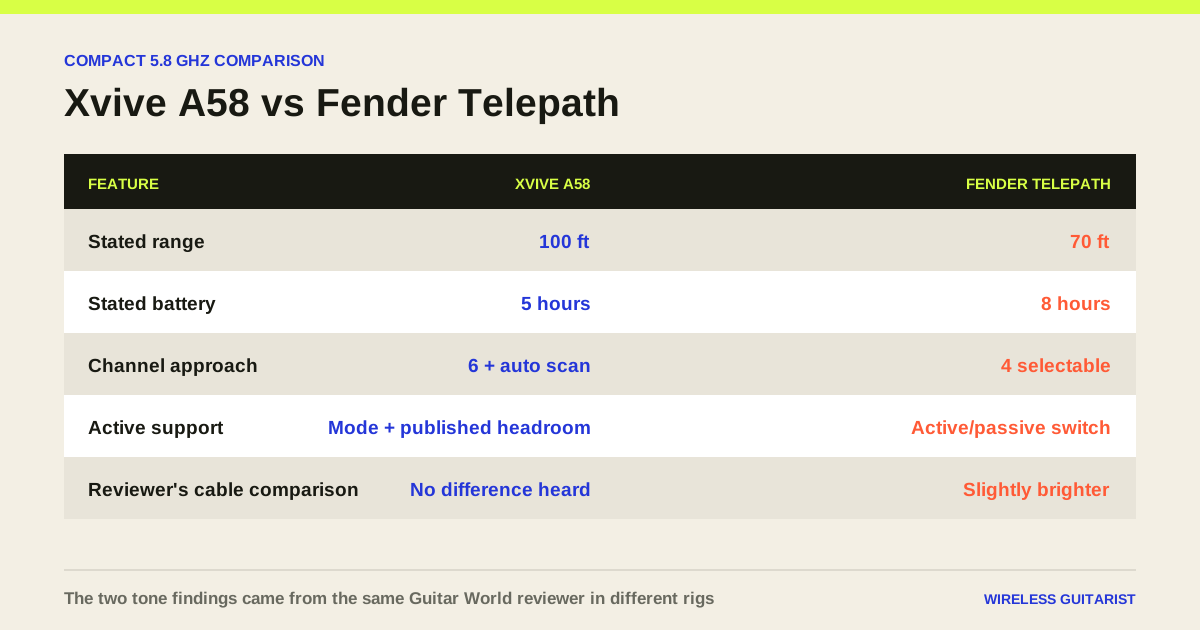
Choose Xvive A58 for automatic channel scanning, six-channel operation and the longer stated range. Choose Fender Telepath for its longer eight-hour battery and simpler four-channel operation. Both explicitly support active and passive pickups.
These are two of the better-specified compact 5.8 GHz systems. Both use hinged quarter-inch plugs, both provide active and passive input modes, and neither requires a receiver fixed to the pedalboard.
The meaningful differences are operational: how channels are chosen, how long the batteries last and how much range the manufacturers claim. Sound-quality adjectives are less useful than those concrete distinctions.
Independent review cross-check
A rare like-for-like review comparison
The same Guitar World reviewer tested both systems in similar settings. Both stayed connected and felt immediate; the differences were tonal presentation, battery life, channel control and how each active mode is implemented.
Xvive A58 review
A58 sounded indistinguishable from the reviewer's cable in that rig, including through drive pedals, and its active mode matched an EMG-equipped guitar. Pairing was quick and the live, rehearsal and home sessions produced no reported dropouts.
Read the original reviewFender Telepath review
Telepath was similarly reliable in the reviewer's test, but sounded slightly brighter than his cable. Its active switch cut level noticeably and its battery reached Fender's eight-hour claim in his use.
Read the original reviewA58 community measurements
Independent community measurements put A58 latency at about 4.8 ms and battery life just over seven hours in a continuous signal test. That supports its published latency and suggests the five-hour battery figure is conservative for that sample.
Read the original reviewA58 has the stronger RF toolset
Xvive provides six channels and a scan function on the receiver. At a new venue, the receiver can identify its clearest channel; you then match the transmitter. Xvive states that up to six sets can operate together and quotes 100 feet line of sight.
Telepath provides four channels and a 70-foot stated range. That is ample for most rehearsal rooms and pub stages, but bands planning several simultaneous instrument links should count channels before choosing it.
Telepath wins on battery life
Fender states eight hours of operation, compared with five hours for A58. Three hours is a meaningful difference: it can be the gap between charging after every rehearsal and charging before the next one.
A58 supports operation while charging, according to Xvive, although tethering a plug-in transmitter defeats its normal purpose and continuous full-charge operation is not ideal for battery longevity. Treat that as an emergency feature, not the routine.
Active-pickup support is a draw—with better numbers from Xvive
Both manufacturers provide active/passive selection. Xvive goes further by publishing maximum input levels: 2.84 V peak-to-peak in passive mode and 7.5 V peak-to-peak in active mode. That makes the A58 easier to assess for very hot instruments on paper.
Fender's Telepath remains the equally straightforward choice for a mixed guitar collection. Its articulated plug is designed to accommodate a range of jack positions, but any deeply recessed or unusually wired socket still deserves a physical check.
Which should you buy?
A58 is the better technical choice for changing venues, several wireless players or a stage where you want to scan rather than guess. Telepath is the calmer ownership choice when eight-hour endurance matters and four manual channels are enough.
For a permanent pedalboard, neither is ideal: the plug-in receiver is exposed and provides no footswitch, wired backup or tuner. In that case, compare Xvive P58, BOSS WL-50 or Shure GLXD16+ instead.
Common questions
Before you buy
Which is better for active pickups?
Both explicitly support active pickups. A58 publishes more detailed input-headroom figures; Telepath offers longer stated battery life.
Can several A58 or Telepath systems work together?
Xvive specifies up to six A58 sets. Telepath offers four channels. Actual capacity can fall in difficult RF conditions.
Which system has less latency?
Fender states 4 ms for Telepath and Xvive states 5 ms for A58. A one-millisecond difference is unlikely to be the deciding factor for most rigs.
Primary sources
Where the specifications came from
Manufacturer figures remain labelled as claims. The independent review links above report what individual reviewers found in their own rigs; they are evidence, not a guarantee of performance in every venue.
Continue researching
More buying guides
BOSS WL-20 vs WL-20L
The practical difference between the BOSS WL-20 and WL-20L, including passive pickups, active pickups, acoustic preamps and cable-tone simulation.
Read guide →Compatibility guideBest systems for active pickups
Wireless guitar systems for EMG, Fishman Fluence and other active pickups, chosen by documented input support rather than guesswork.
Read guide →Pedalboard guideBest pedalboard wireless systems
Compare BOSS WL-50, Xvive P58, BOSS WL-60, Sennheiser XSW-D and Shure GLXD16+ for pedalboard use.
Read guide →