Compatibility guide
Best wireless guitar systems for active pickups
Wireless guitar systems for EMG, Fishman Fluence and other active pickups, chosen by documented input support rather than guesswork.
For a compact set, start with the Xvive A58 or Fender Telepath because both provide explicit active/passive modes. For a pedalboard, Xvive P58 carries the A58 transmitter into a tuner receiver. For working stages, Shure GLXD16+ is the stronger long-term system.
Active pickups do not automatically need an expensive wireless system. They do need the right input. A hot, low-impedance output can expose problems that stay hidden with a passive guitar: insufficient headroom, odd battery-switch wiring or noise caused by the transmitter sitting beside the active circuit.
Start with products whose manufacturers explicitly address active instruments. A broad claim about quarter-inch connectivity says nothing about input headroom or battery-switch wiring.
Independent review cross-check
What independent testing says about hot outputs
A58 has both a published active mode and an independent community bench test of its headroom. Telepath's active setting has been tested with EMG pickups. GLXD16+ uses a bodypack cable, avoiding plug-in jack-wiring complications.
Xvive A58 review
The reviewer used an EMG-equipped guitar and found the active setting a suitable match. Across a live show, rehearsal and home use, he reported intact dynamics, no audible latency and no dropouts in those tests.
Read the original reviewA58 community bench test
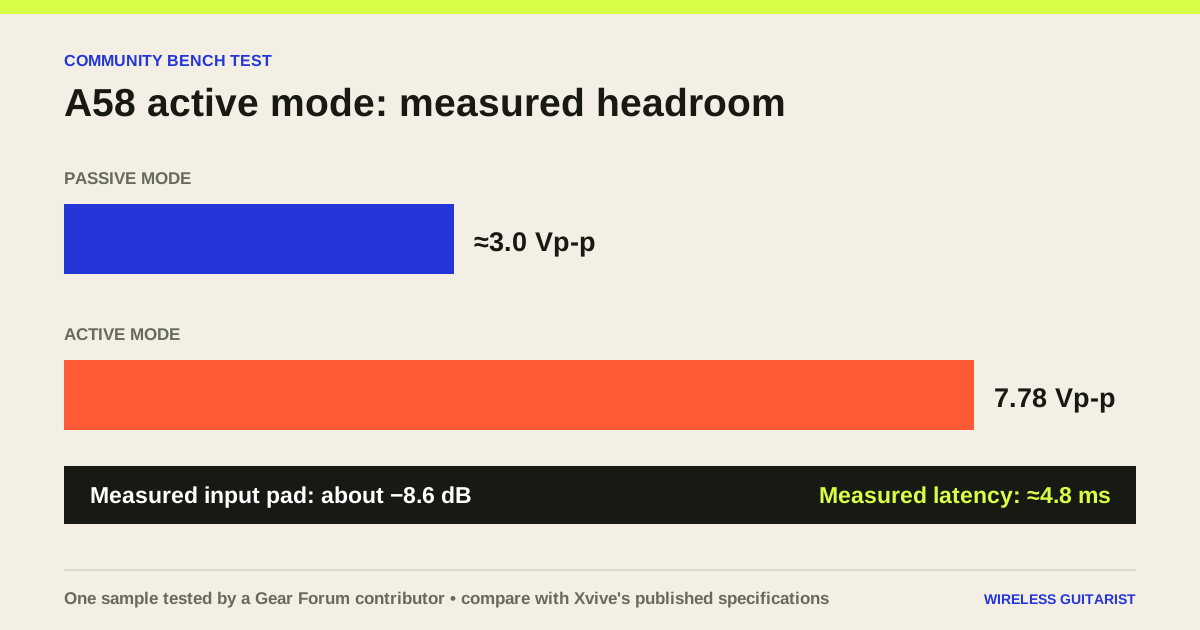
A user bench test measured clipping at roughly 3 Vp-p in passive mode and 7.78 Vp-p in active mode, with an 8.6 dB input pad. It is not a certified laboratory report, but it independently verifies that the mode changes real headroom.
Read the original reviewFender Telepath review
Testing with an EMG-loaded guitar confirmed a substantial level reduction in active mode. The same review found the wireless tone slightly brighter than a 15-foot cable, which may matter more than the band choice to some players.
Read the original reviewThe compact picks: A58 and Telepath
Xvive gives the A58 separate passive and active modes. Its published maximum input rises from 2.84 V peak-to-peak in passive mode to 7.5 V peak-to-peak in active mode, with a 10 dB reduction. That is unusually useful documentation: it tells us the switch changes headroom rather than merely changing a label.
Fender's Telepath also includes an active/passive input switch and uses the 5.8 GHz band. Its eight-hour stated battery is three hours longer than the A58's, while A58 provides six channels, automatic scanning and a longer 100-foot stated range. Choose Telepath for endurance and simplicity; choose A58 for channel scanning and published input detail.
The pedalboard picks: P58 and GLXD16+
Xvive P58 uses the same active-capable A58 transmitter with a true-diversity pedal receiver, tuner, wired input and selectable bypass. It is the neatest mid-priced route if you want the receiver fixed to the board.
Shure GLXD16+ moves to a bodypack, locking instrument cable and dual-band receiver. It costs substantially more, but its replaceable cable, twelve-hour stated battery and automatic use of both 2.4 and 5.8 GHz make sense for equipment expected to work every week. The bodypack also keeps the transmitter away from the guitar's active electronics.
Why a plug-in transmitter sometimes produces no sound
Many active instruments use a TRS output socket as an on/off switch for the onboard battery. A normal mono guitar plug bridges the appropriate contacts. A plug-in wireless transmitter may not mimic that plug mechanically or electrically in exactly the same way.
BOSS publishes a specific warning that some active guitars reverse the usual ring and sleeve arrangement. The result can be silence or a thumping sound. This does not mean active pickups are incompatible with wireless; it means the exact output-jack wiring matters. A short conventional cable into a bodypack, or an approved extension arrangement, avoids many of these edge cases.
A five-minute check before relying on it live
Test every pickup position with the guitar volume fully open, then strike the lowest strings hard. Listen for crunch or compression that disappears with a cable. Move the transmitter while the instrument is sounding and listen for digital whine. Finally, walk the actual performance area with the venue's Wi-Fi and the rest of the band's wireless equipment switched on.
That test does not replace RF coordination, but it catches the three failures most likely to be specific to your rig: input overload, proximity noise and a poor local channel.
Common questions
Before you buy
Do active pickups need a special wireless system?
Not always, but an explicit active mode, suitable input headroom or a bodypack with a documented instrument input reduces uncertainty.
Is 5.8 GHz better for active pickups?
Frequency band and pickup compatibility are separate issues. A 5.8 GHz system can still have an unsuitable input; look for documented active support first.
Can an active guitar damage a wireless transmitter?
Normal instrument outputs should not damage a compatible transmitter, but an excessively hot signal can clip its input. Follow the manufacturer's level guidance.
Primary sources
Where the specifications came from
Manufacturer figures remain labelled as claims. The independent review links above report what individual reviewers found in their own rigs; they are evidence, not a guarantee of performance in every venue.
Continue researching
More buying guides
BOSS WL-20 vs WL-20L
The practical difference between the BOSS WL-20 and WL-20L, including passive pickups, active pickups, acoustic preamps and cable-tone simulation.
Read guide →Pedalboard guideBest pedalboard wireless systems
Compare BOSS WL-50, Xvive P58, BOSS WL-60, Sennheiser XSW-D and Shure GLXD16+ for pedalboard use.
Read guide →RF explainer2.4 GHz vs 5.8 GHz
How to choose between 2.4 GHz and 5.8 GHz wireless guitar systems for home, rehearsal rooms and live venues.
Read guide →