Pedalboard guide
Best pedalboard wireless guitar systems
Compare BOSS WL-50, Xvive P58, BOSS WL-60, Sennheiser XSW-D and Shure GLXD16+ for pedalboard use.
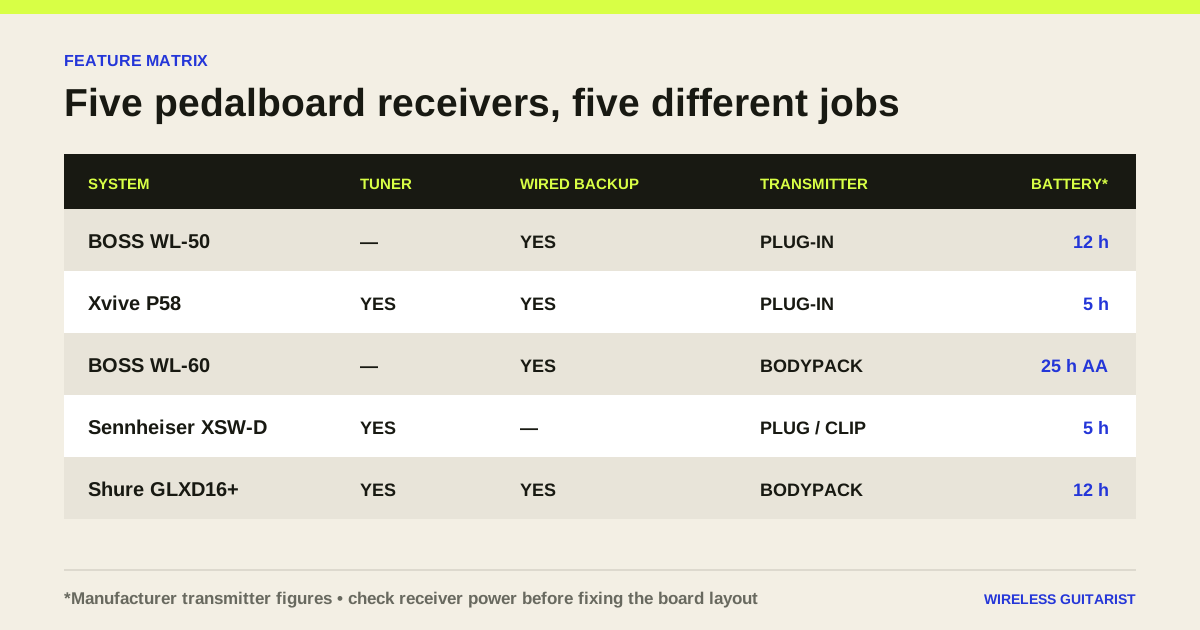
BOSS WL-50 is the easy recommendation for a conventional board. Xvive P58 is better when 5.8 GHz and a built-in tuner are priorities. Shure GLXD16+ is the stage-focused choice; BOSS WL-60 is the practical alternative for players who prefer replaceable AA batteries.
Moving the receiver onto a pedalboard should earn its board space. The useful models also charge the transmitter, tune, display RF conditions, accept a wired backup or keep the instrument cable serviceable.
Board space, power supply and transmitter routine matter as much as latency. The best choice is the one that still makes sense during setup, soundcheck and the moment a battery warning appears before the encore.
Independent review cross-check
What survives contact with a real pedalboard
Hands-on reviews repeatedly favour simple pairing and a wired escape route. They also expose details that spec sheets underplay: transmitter fit, tuner behaviour, power demand and whether the charging routine works at a gig.
BOSS WL-50 review
The WL-50 paired quickly, covered the reviewer's working distance and only dropped after moving well away through adjoining rooms. The review also flags the rigid plug and active-pickup compatibility as the two practical checks before purchase.
Read the original reviewSennheiser XSW-D Pedalboard review
The reviewer found the sound and latency convincing, but preferred the supplied extension lead and strap clip on a Telecaster. That is a useful warning for any jack position where a plug-in transmitter can swing or take a knock.
Read the original reviewSennheiser XSW-D quick review
A second review praised setup, clarity and reliability but called the tuner slow and the system expensive. Players buying it for the combined tuner and receiver should try the tuner response before removing their existing pedal.
Read the original reviewShure GLXD16+ review
The Shure earned praise for its metal construction, quick setup, clear battery monitoring and 15-minute emergency charge. The extra cost buys operational resilience and a more serviceable stage routine.
Read the original reviewBest all-rounder: BOSS WL-50
WL-50 is compact, quick to pair and unusually easy to keep charged because the WL-T transmitter docks in the receiver. Its 2.3 ms stated latency is the lowest in this group, and the cable-tone switch makes it workable across passive and active instruments when the transmitter fits correctly.
The receiver can distribute DC power to other pedals when it is powered by the specified BOSS adaptor. Do not assume any spare daisy-chain arrangement will be quiet or adequate; check the current requirements of the whole board.
Best mid-priced 5.8 GHz board: Xvive P58
P58 combines the active-capable A58 transmitter with a tuner receiver. It scans six 5.8 GHz channels, offers a conventional wired input and lets you choose true or buffered bypass. The pedal therefore replaces a tuner as well as receiving the instrument signal.
Its limitation is endurance. The stated five-hour transmitter battery is enough for many shows but leaves less margin across a long rehearsal, support slot and headline set. The receiver also needs 9–12 V DC at a minimum 200 mA, so confirm a suitable isolated output before fixing the board layout.
Best for visible control: BOSS WL-60
WL-60 trades the plug-in transmitter for a bodypack and short cable. In return, the receiver gives you a clear channel scan, channel selection and battery indication. The bodypack runs for up to 25 hours on two alkaline AA cells according to BOSS, which is reassuring when charging opportunities are uncertain.
This is a good working-musician design: the short cable is replaceable, the battery is replaceable and the RF choice is visible. It is less elegant for home use, but every supposed inconvenience is also a serviceability advantage.
The premium choices: XSW-D and GLXD16+
Sennheiser XSW-D Pedalboard has an exceptional 75-metre stated range in optimal conditions and a simple one-touch operating model. Its five-hour transmitter life is the constraint; buyers attracted by the range should plan charging just as seriously.
Shure GLXD16+ is the most complete system here. It has a metal receiver, tuner, wired true-bypass input, bodypack and automatic dual-band operation. Shure specifies a minimum 400 mA at 9 V, so it needs a serious pedalboard output. The price and power demand are justified only if the system will see regular live work.
Power and placement checklist
Put the receiver where its antennas and status display are not buried by metal flightcase walls or a dense bundle of digital power cables. Use the manufacturer's stated supply voltage, polarity and current. Keep a normal guitar cable already connected or immediately accessible; a backup that takes ten minutes to install is not a backup.
- Confirm voltage, polarity and minimum current before buying.
- Leave room to dock or remove the transmitter.
- Check whether the wired input mutes or switches the wireless path.
- Run the receiver before gain-sensitive pedals unless the manufacturer specifies otherwise.
Common questions
Before you buy
Where should a wireless receiver go in the pedal chain?
Normally at the start, where the guitar cable would enter. A separate buffer or unusual routing system may change that decision.
Can a pedal receiver power other pedals?
BOSS WL-50 provides a DC output when correctly powered. Do not assume other receivers do, and stay within the supply's total current capacity.
Do I still need a tuner pedal?
P58, XSW-D Pedalboard and GLXD16+ include tuning functions. Whether they replace your existing tuner depends on display preference and switching behaviour.
Primary sources
Where the specifications came from
Manufacturer figures remain labelled as claims. The independent review links above report what individual reviewers found in their own rigs; they are evidence, not a guarantee of performance in every venue.
Continue researching
More buying guides
BOSS WL-20 vs WL-20L
The practical difference between the BOSS WL-20 and WL-20L, including passive pickups, active pickups, acoustic preamps and cable-tone simulation.
Read guide →Compatibility guideBest systems for active pickups
Wireless guitar systems for EMG, Fishman Fluence and other active pickups, chosen by documented input support rather than guesswork.
Read guide →RF explainer2.4 GHz vs 5.8 GHz
How to choose between 2.4 GHz and 5.8 GHz wireless guitar systems for home, rehearsal rooms and live venues.
Read guide →