UK spectrum guide
Wireless guitar system frequencies in the UK
A practical UK guide to licence-exempt and licensed spectrum for wireless guitar systems, with current Ofcom sources.
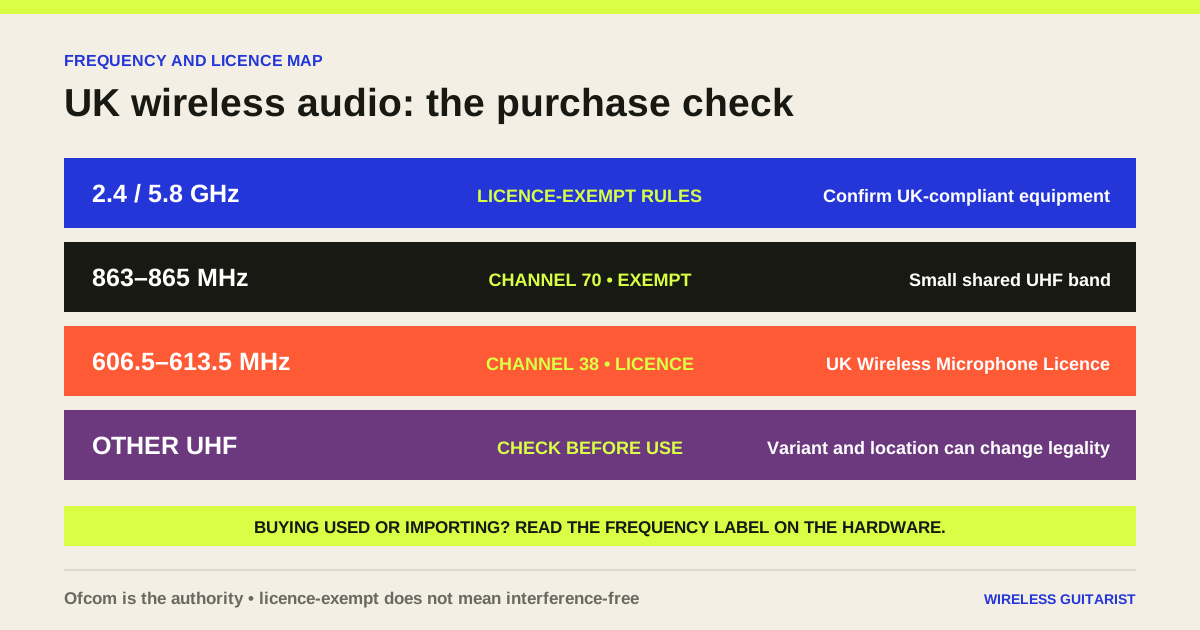
Most consumer digital guitar systems in this guide use 2.4 GHz or 5.8 GHz. Buy a UK-market version from a reputable retailer and follow its declaration of conformity. UHF bodypack systems require closer attention because some bands are licence-exempt and others require a UK Wireless Microphone Licence or site coordination.
A wireless guitar transmitter is radio equipment. The fact that a product is sold online—or works when switched on—does not establish that every frequency variant is lawful to use in the UK.
The practical risk is greatest with imported UHF systems offered in several regional bands. Compact 2.4 GHz and 5.8 GHz digital sets are simpler, but they still need to be compliant UK-market equipment used within the manufacturer's conditions.
Independent review cross-check
The legal check is different from a product review
A review can tell you whether a system worked in one room. It cannot establish whether a particular frequency variant is lawful in the UK. For this page, Ofcom is the authority and Canford provides the clearest independent cross-check.
PMSE licence information
Ofcom states that licence-exempt equipment must still comply with the relevant technical rules. Its UK Wireless Microphone Licence covers shared access to Channel 38; other UHF ranges can require different assignments.
Read the original reviewUK legal radio microphone frequency guide
Canford's current technical guide usefully separates licence-exempt spot frequencies and Channel 70 from licensed Channel 38. It also shows why an overseas bargain can be unusable here even when the hardware looks identical.
Read the original reviewThe licence-exempt bands Ofcom identifies
Ofcom lists 173.8–175 MHz, 863–865 MHz and 2400–2483.5 MHz as licence-exempt for wireless microphones and monitors, subject to the relevant technical requirements. Licence-exempt means you do not buy an individual operating licence; it does not reserve the channel or protect you from other users.
The 2.4 GHz systems in this catalogue sit in shared spectrum also used by Wi-Fi, Bluetooth and other equipment. Congestion is therefore a reliability question even when the equipment is legally compliant.
UHF equipment may need a licence
Ofcom offers shared UK wireless-microphone licences for specified UHF frequencies and coordinated licences for particular sites. These give access to spectrum beyond the small licence-exempt allocations, but shared channels still do not guarantee freedom from local users.
Never choose a UHF system by price alone. Confirm the exact frequency block printed on the transmitter and receiver, then compare it with current Ofcom guidance or ask the retailer to identify the UK-approved variant. A US or Asian-market frequency version can look identical to the UK one.
What about 5.8 GHz guitar systems?
Products such as Xvive A58 and Fender Telepath are sold as 5.8 GHz systems and provide their own declarations and regional specifications. The detailed exemption conditions for short-range devices are more technical than a product-category label, so the safe purchasing rule is to buy the UK/EU-market model from an authorised seller rather than importing an unspecified variant.
Keep the documentation. A declaration of conformity and the model's regulatory markings are more useful than a marketplace listing that merely says 'global frequency'.
Buying checklist for a UK player
This is operational guidance, not legal advice. Spectrum rules and licence products can change, and large productions often use a professional RF coordinator.
- Buy the UK-market frequency variant from a retailer that identifies it clearly.
- Check the exact frequency range, not simply 'UHF' or 'digital'.
- Retain the declaration of conformity and model documentation.
- Use Ofcom's current page before buying or hiring UHF equipment.
- For festivals, theatres and multi-channel productions, coordinate with the venue or an RF professional.
Common questions
Before you buy
Do I need a licence for a 2.4 GHz wireless guitar system in the UK?
Ofcom lists 2400–2483.5 MHz as licence-exempt subject to the applicable equipment requirements. Use a compliant UK-market product.
Is all UHF wireless guitar equipment legal without a licence?
No. Some small bands are licence-exempt, while other UHF frequencies require a shared or coordinated licence.
Does licence-exempt mean interference-free?
No. Licence-exempt users share spectrum and receive no exclusive channel protection.
Primary sources
Where the specifications came from
Manufacturer figures remain labelled as claims. The independent review links above report what individual reviewers found in their own rigs; they are evidence, not a guarantee of performance in every venue.
Continue researching
More buying guides
BOSS WL-20 vs WL-20L
The practical difference between the BOSS WL-20 and WL-20L, including passive pickups, active pickups, acoustic preamps and cable-tone simulation.
Read guide →Compatibility guideBest systems for active pickups
Wireless guitar systems for EMG, Fishman Fluence and other active pickups, chosen by documented input support rather than guesswork.
Read guide →Pedalboard guideBest pedalboard wireless systems
Compare BOSS WL-50, Xvive P58, BOSS WL-60, Sennheiser XSW-D and Shure GLXD16+ for pedalboard use.
Read guide →