Latency guide
Best low-latency wireless guitar systems
Compare stated wireless guitar latency and understand how it combines with modelers, digital pedals and in-ear monitoring.
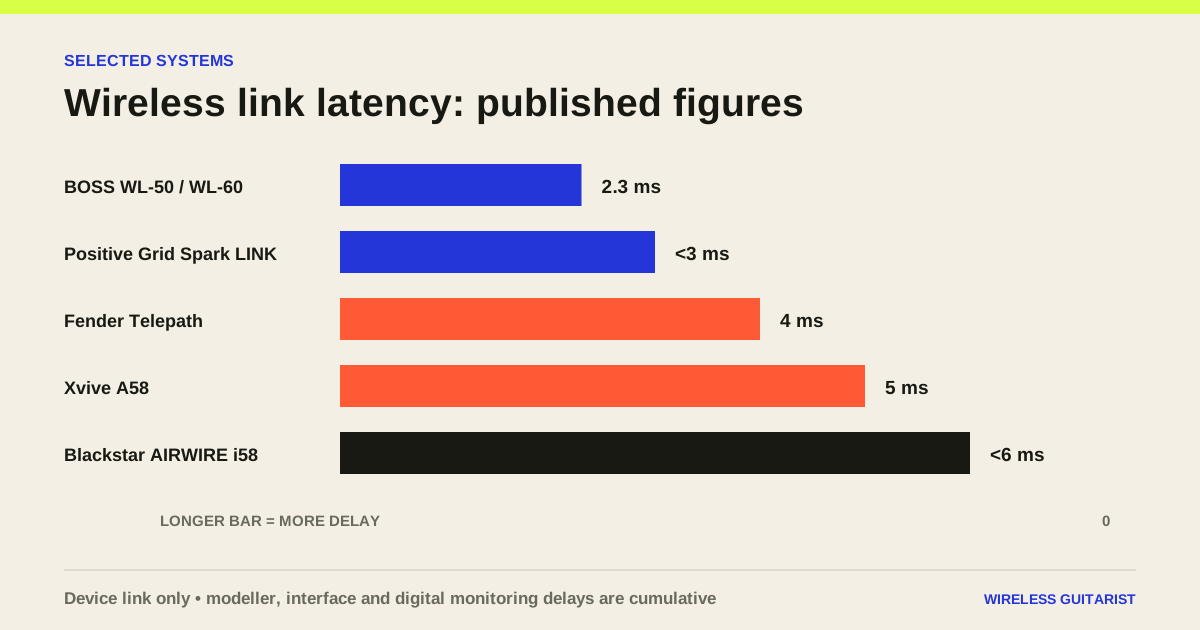
BOSS WL-50 and WL-60 lead this catalogue at a stated 2.3 ms; Positive Grid Spark LINK is under 3 ms. Those are sensible choices for already-digital rigs. Calculate the whole signal path before paying extra to save a single millisecond at the guitar link.
Wireless latency is easy to compare because it comes as a number. It is also easy to overvalue. A difference between 2.3 and 4 milliseconds is much less important than an unreliable link, the wrong input for the guitar or another ten milliseconds elsewhere in the rig.
The right question is whether the complete path—from the string to the ear—stays comfortable. That path may include the wireless transmitter, a digital modeler, a digital console and wireless in-ear monitors.
Independent review cross-check
Published latency versus playing experience
Only one system in this group has a useful third-party bench measurement in the sources we found. The other reviews supply subjective checks. That distinction matters: ‘I could not feel it’ is valuable field evidence, but it is not a millisecond measurement.
Xvive A58 community bench test
The test measured about 4.8 ms against Xvive's 5 ms specification. It is a single community measurement, but it is more informative than repeating the box figure alone.
Read the original reviewBOSS WL-50 review
An A/B test found no perceived lag or meaningful tonal difference from a cable in the reviewer's rig. The review did not independently measure the stated 2.3 ms figure.
Read the original reviewSennheiser XSW-D review
The reviewer reported no delayed or softened attack while playing. Again, that is a practical perception test, not an instrumented measurement of Sennheiser's published figure.
Read the original reviewFender Telepath review
Telepath's four-millisecond claim was not bench-tested, but the reviewer reported no loss of engagement at normal playing distances across home, rehearsal and a small live venue.
Read the original reviewThe fastest stated figures in this catalogue
BOSS specifies 2.3 ms for WL-20, WL-50 and WL-60. Positive Grid specifies less than 3 ms for Spark LINK. Sennheiser states less than 4 ms for XSW-D, while Shure publishes a 4 ms figure for GLXD16+ in our current source set. Xvive A58 and P58 are listed at 5 ms; Blackstar AIRWIRE i58 at 6 ms.
These are manufacturer figures, not measurements made under one common test method. Treat them as useful specifications, not a laboratory ranking with tenths-of-a-millisecond precision.
Latency adds across the signal chain
Digital stages add delay. If a guitar link contributes 4 ms, a modeler contributes several more and the monitor path converts the signal again, the player experiences the sum. A conventional amplifier in the room avoids some of those later stages; an all-digital in-ear rig does not.
Distance also has a useful real-world comparison: sound travelling through air takes roughly 3 ms per metre. A guitarist standing three metres from a loud cabinet already hears about 9 ms of acoustic travel time. That does not make electronic delay irrelevant, but it puts small specification differences in context.
When to prioritise the lowest number
Low wireless latency deserves extra weight when the rest of the rig is already digital, when monitoring is through IEMs rather than a nearby cabinet, or when the playing style relies on very immediate transient feedback. BOSS WL-50 is a strong pedalboard fit; WL-60 adds visible channel control and a bodypack.
For a simple guitar-to-analogue-amp setup, a stable 4 or 5 ms system is unlikely to be rejected solely on feel by most players. Battery routine, RF conditions and pickup compatibility should decide the purchase first.
How to compare honestly
Bypass the wireless link with a normal cable without changing anything else. Match levels carefully, because louder often feels more immediate. Record both paths into separate interface channels if you want to measure your own rig; do not rely on moving between two performances by ear.
- Compare total rig latency, not the transmitter in isolation.
- Keep output levels matched.
- Include the monitor system in the test.
- Choose stability over a tiny numerical advantage.
Common questions
Before you buy
How much wireless guitar latency is noticeable?
There is no universal threshold. Context, playing style and other digital stages matter. Figures around 2–5 ms are small, but they still add to the rest of the rig.
Is 5 ms too slow for guitar?
Not by itself for most players. The concern is the accumulated latency of the wireless link, processing and monitor chain.
Does 5.8 GHz mean lower latency than 2.4 GHz?
No. Products in either band can be faster or slower; latency is determined by the system design.
Primary sources
Where the specifications came from
Manufacturer figures remain labelled as claims. The independent review links above report what individual reviewers found in their own rigs; they are evidence, not a guarantee of performance in every venue.
Continue researching
More buying guides
BOSS WL-20 vs WL-20L
The practical difference between the BOSS WL-20 and WL-20L, including passive pickups, active pickups, acoustic preamps and cable-tone simulation.
Read guide →Compatibility guideBest systems for active pickups
Wireless guitar systems for EMG, Fishman Fluence and other active pickups, chosen by documented input support rather than guesswork.
Read guide →Pedalboard guideBest pedalboard wireless systems
Compare BOSS WL-50, Xvive P58, BOSS WL-60, Sennheiser XSW-D and Shure GLXD16+ for pedalboard use.
Read guide →